By creating an account at francobordo.com you can make your purchases quickly in our virtual store, check the status of your orders and check your previous operations.
Ahead! We were waiting for you.
Register and take advantage of the discounts and advantages of being a Professional of Nautical
Join the more than 500 Nautical Professionals now
We are sorry, but this product is discontinued and will not be available for purchase again.
● Lithium-iron-phosphate (LiFePO4 or LFP) is the safest of the mainstream li-ion battery types. The nominal
voltage of a LFP cell is 3,2V (lead-acid: 2V/cell). A 12,8V LFP battery therefore consists of 4 cells connected in
series; and a 25,6V battery consists of 8 cells connected in series.
● Rugged
A lead-acid battery will fail prematurely due to sulfation:
• If it operates in deficit mode during long periods of time (i.e. if the battery is rarely, or never at all,
fully charged).
• If it is left partially charged or worse, fully discharged (yacht or mobile home during wintertime).
A LFP battery does not need to be fully charged. Service life even slightly improves in case of partial charge
instead of a full charge. This is a major advantage of LFP compared to lead-acid.
Other advantages are the wide operating temperature range, excellent cycling performance, low internal
resistance and high efficiency (see below).
LFP is therefore the chemistry of choice for very demanding applications.
● Efficient
In several applications (especially off-grid solar and/or wind), energy efficiency can be of crucial importance.
The round trip energy efficiency (discharge from 100% to 0% and back to 100% charged) of the average leadacid
battery is 80%.
The round trip energy efficiency of a LFP battery is 92%.
The charge process of lead-acid batteries becomes particularly inefficient when the 80% state of charge has
been reached, resulting in efficiencies of 50% or even less in solar systems where several days of reserve energy
is required (battery operating in 70% to 100% charged state).
In contrast, a LFP battery will still achieve 90% efficiency under shallow discharge conditions.
● Size and weight
Saves up to 70% in space
Saves up to 70% in weight
● Expensive?
LFP batteries are expensive when compared to lead-acid. But in demanding applications, the high initial cost
will be more than compensated by longer service life, superior reliability and excellent efficiency.
● Endless flexibility
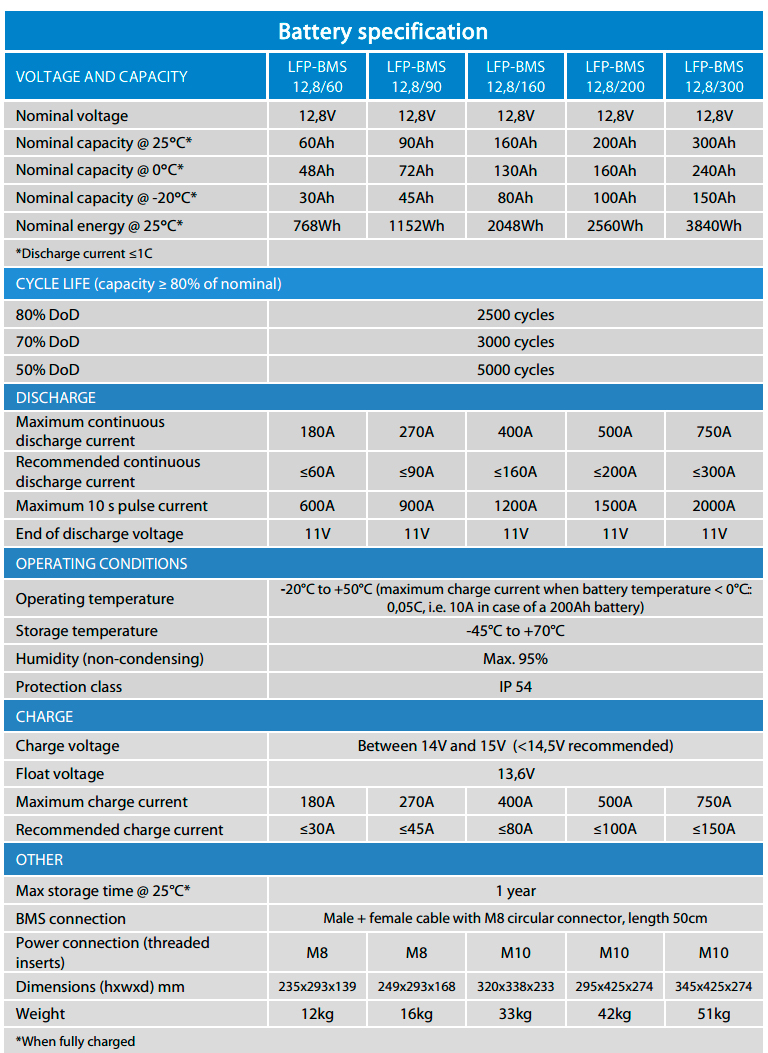
LFP batteries are easier to charge than lead-acid batteries. The charge voltage may vary from 14 V to 15 V (as
long as no cell is subjected to more than 4,2 V), and they do not need to be fully charged. Therefore several
batteries can be connected in parallel and no damage will occur if some batteries are less charged than others.
● With or without Battery Management System (BMS)?
Important facts:
1. A LFP cell will fail if the voltage over the cell falls to less than 2,5V (note: recovery by charging with a low
current, less than 0,1C, is sometimes possible).
2. A LFP cell will fail if the voltage over the cell increases to more than 4,2V.
Lead-acid batteries will eventually also be damaged when discharged too deeply or overcharged, but not
immediately. A lead-acid battery will recover from total discharge even after it has been left in discharged state
during days or weeks (depending on battery type and brand).
3. The cells of a LFP battery do not auto-balance at the end of the charge cycle.
The cells in a battery are not 100% identical. Therefore, when cycled, some cells will be fully charged or
discharged earlier than others. The differences will increase if the cells are not balanced/equalized from time to
time.
In a lead-acid battery a small current will continue to flow even after one or more cells are fully charged (the
main effect of this current is decomposition of water into hydrogen and oxygen). This current helps to fully
charge other cells that are lagging behind, thus equalizing the charge state of all cells.
The current which flows through a fully-charged LFP cell however, is nearly zero, and lagging cells will therefore
not be fully charged. Over time the differences between cells may become so extreme that, even though the
overall battery voltage is within limits, some cells will fail due to over- or under voltage. Cell balancing is
therefore highly recommended.
In addition to cell balancing, a BMS will:
- Prevent cell under voltage by timely disconnecting the load.
- Prevent cell overvoltage by reducing charge current or stopping the charge process.
- Shut down the system in case of over temperature.
A BMS is therefore indispensable to prevent damage to Li-ion batteries.
Our LFP batteries have integrated cell balancing and cell monitoring. Up to ten batteries can be paralleled and up to four batteries can
be series connected, so that a 48V battery bank of up to 3000Ah can be assembled. The cell balancing/monitoring cables can be daisychained
and must be connected to a Battery Management System (BMS).
● Battery Management System (BMS)
The BMS will:
1. Disconnect or shut down the load whenever the voltage of a battery cell falls to less than 2,5V.
2. Stop the charging process whenever the voltage of a battery cell increases to more than 4,2V.
3. Shut down the system whenever the temperature of a cell exceeds 50°C.
More features may be included: see the individual BMS datasheets