| |
Speed
in knots |
Range
in mm |
Run time
in hours |
| Slow speed |
1.5 - 2.0 |
9.6 - 12.8 |
6:20 |
| Half throttle |
2.5 - 3.0 |
5.3 - 6.4 |
2:08 |
| Full throttle |
3.6 - 4.0 |
2.6 - 2.8 |
0:42 |
Which Travel for which boat?
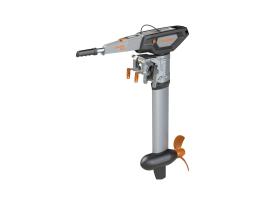
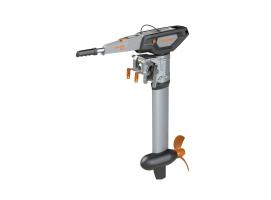
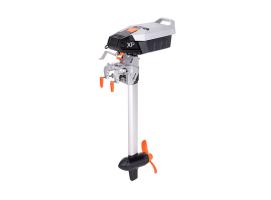
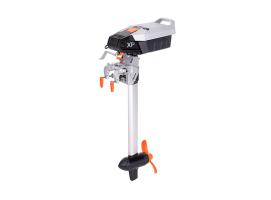
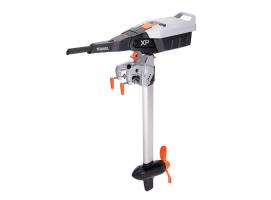
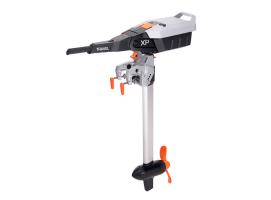
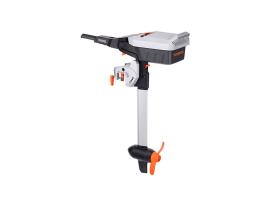
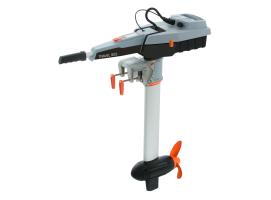
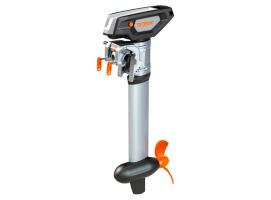
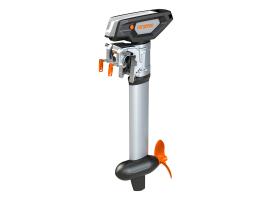
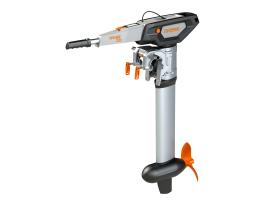
● Both models are suitable for inflatables and other small boats. For sailboats, we recommend the Travel 503 for boats up to 750 kg. The Travel 1003 easily propels up to 1.5 tons. Both models consume comparable levels of energy at the same speed. The Travel 1003 has a higher maximum power and offers over 60% more battery capacity, providing longer range. Both models are available in long and short shaft versions.
Battery charging
● From fully discharged, charging with the charger provided takes approximately 9 hours (Travel 503) and 15 hours (Travel 1003).
Lithium battery life expectancy
● The life of a lithium battery is barely affected by charging cycles. It has no memory effect. Therefore, the battery can be fully recharged after every trip, regardless of the charge status shown on the display. Generally, a loss of capacity of 4% per year can be expected. Ageing is accelerated if the battery is exposed to high temperatures for long periods while fully charged. The battery can be used in very hot conditions, but we would recommend that it should be stored in a cool place away from the sun when not in use. 8 years after date of production, your battery needs to be inspected by a service center.
Integrated battery life expectancy
● The Travel 503 battery has a capacity of 320 Wh and the Travel 1003 provides 520 Wh. For the Travel 503, this gives a rating of 11 Ah at 29.6 V and the Travel 1003, 18 Ah at 29.6 V.
Solar Charging
● The batteries of the Travel 503 and 1003 models can be charged by a solar charger, even when the motor is in use on the water. The battery is compatible with solar chargers with voltages between 24 and 60 V and a maximum charging current of up to 4 A. The simplest solution is to charge via our SUN 45 W - Solar panel.
Charging from the on-board power supply
● To charge the battery from an on-board power supply, an inverter is required to convert the voltage to between 100 and 240 V (standard power outlet voltages that can vary from country to country). High-efficiency inverters are available commercially at low cost.
Safety
● The motor only runs when the magnetkey is placed in position on the throttle and stops immediately when the key is removed. For safety reasons, the magnet key should be attached to the wrist or the life vest.
Temperature protection
● In warmer climates, you may experience a reduction in power after 15-30 minutes running at full throttle. This is not a defect, but the integrated temperature protection mode that ensures that the battery does not reach extreme temperatures. Temperature protection mode is indicated by a thermometer in the display.
♦ Technical Data:
 Input power: 500 watts